

from Rio Grande Resources (CVE:RGR)
Rio Grande Resources Reports Gold up to 41.2 g/t and Silver up to 1,435 g/t at Its Winston Project, New Mexico
High-Grade Samples Returned in a New Previously Unsampled Area of Poverty Creek and Identifies Multiple Structural Trends
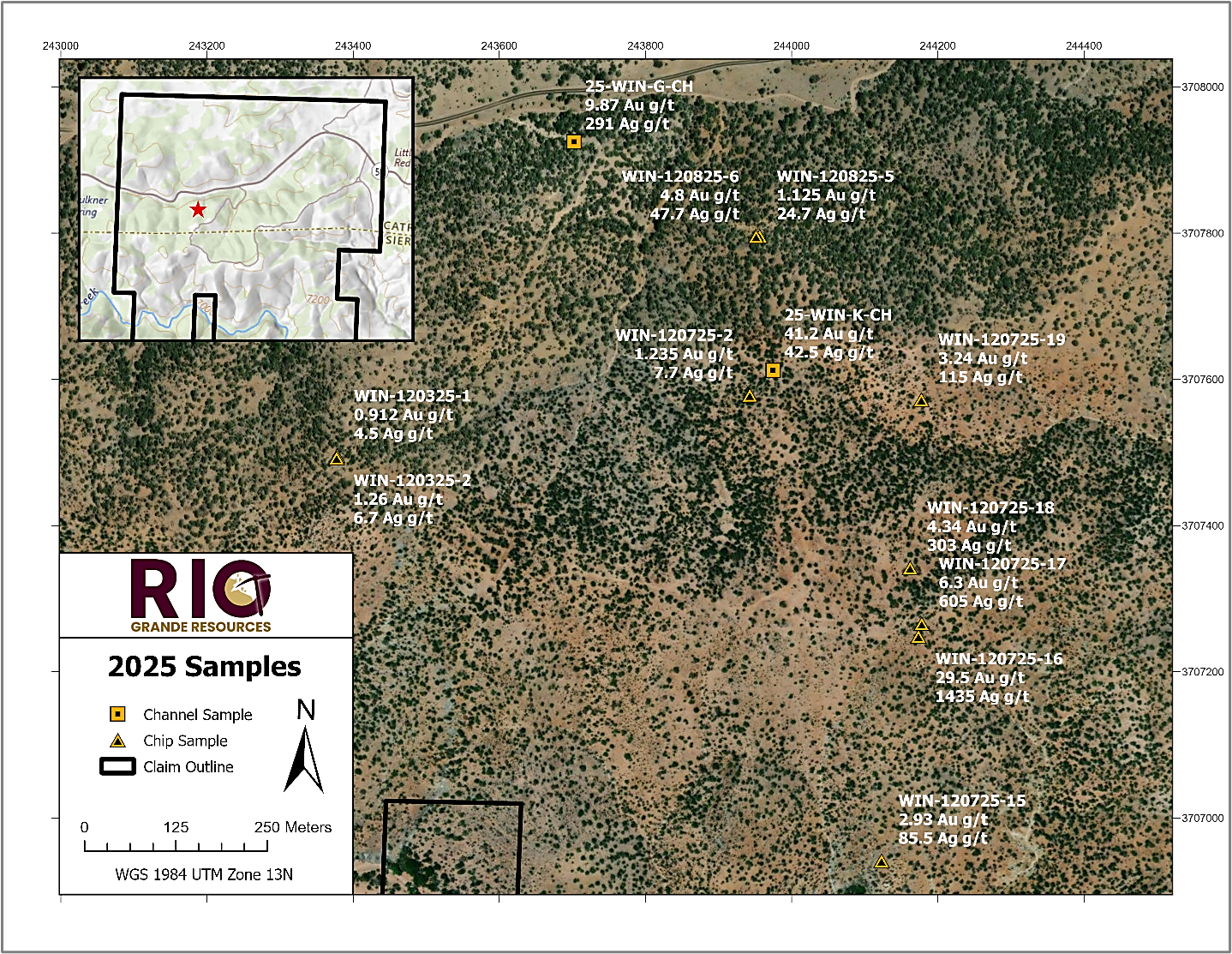
VANCOUVER, BC / ACCESS Newswire / February 19, 2026 / Rio Grande Resources Ltd. (CSE:RGR)(OTCQB:RGRLF) ("Rio Grande" or the "Company") is pleased to announce assay results from its December 2025 surface sampling campaign (see News Release, December 22, 2025) carried out by Dahrouge Geological Consulting USA Ltd. ("Dahrouge") at the Winston Gold-Silver Project (the "Winston Project" or the "Project") located in the Black Range Mountains of Sierra County, New Mexico. The program returned results (figure 1) from a newly identified and previously unsampled mineralized area within the Poverty Creek area of the Project referred to as the "Poverty Creek Trend." Sampling returned gold values up to 41.2 g/t Au and silver values up to 1,435 g/t Ag, further confirming high-grade precious metal mineralization across multiple structurally controlled zones within the property.
Sampling Program Overview
Dahrouge completed a reconnaissance surface sampling and mapping program across the Winston claim block. A total of 72 samples were collected, including 11 channel samples from exposed in situ veins and 39 rock chip samples from vein outcrops, subcrops, and historic workings. The program was designed to evaluate structural continuity, identify mineralized trends, and refine priority target areas for follow-up work for potential future drill testing. Sample Highlights Include:
WIN-120725-16 - Gold: 29.5 g/t - Silver: 1,435 g/t
WIN-120725-17 - Gold: 6.3 g/t - Silver: 605 g/t
WIN-120725-18 - Gold: 4.34 g/t - Silver: 303 g/t
25-WIN-G-CH - Gold: 9.87 g/t - Silver: 291 g/t
Poverty Creek Trend - Northern Claim Block
The newly identified Poverty Creek Trend is a northeast-southwest striking mineralized vein system located in the northern portion of the claim block. The trend is defined by mapped quartz vein exposures, historic workings, structural splays, and associated geochemical results. First-pass sampling within the Poverty Creek Trend included eight rock chip samples and one float sample, and confirmed along-strike continuity of mineralized vein material in a previously unsampled area.
The area is characterized by:
Multiple quartz vein subcrops and prospect pits
A previously unmapped adit
A filled shaft along a nearby parallel vein
Vein material exhibiting dark banded sulphides and vuggy quartz textures
These new sampling results, when integrated with known mineralization at the past-producing Ivanhoe, Emporia, and Little Granite mines, support the interpretation of a continuous, structurally controlled mineralized corridor extending from the southern portion of the claim block through the newly defined Poverty Creek Trend in the north as shown in figure 2 below.
Based on mapped vein orientations, channel results, and the spatial distribution of high-grade rock chip samples, the Company interprets mineralization to extend over an approximate 2.0 kilometre north-south strike length within the Winston claim block. The identification of high-grade gold and silver in the previously unsampled Poverty Creek area expands the known mineralized footprint beyond historically developed zones and confirms the presence of multiple sub-parallel and splay vein systems within a broader structural framework.
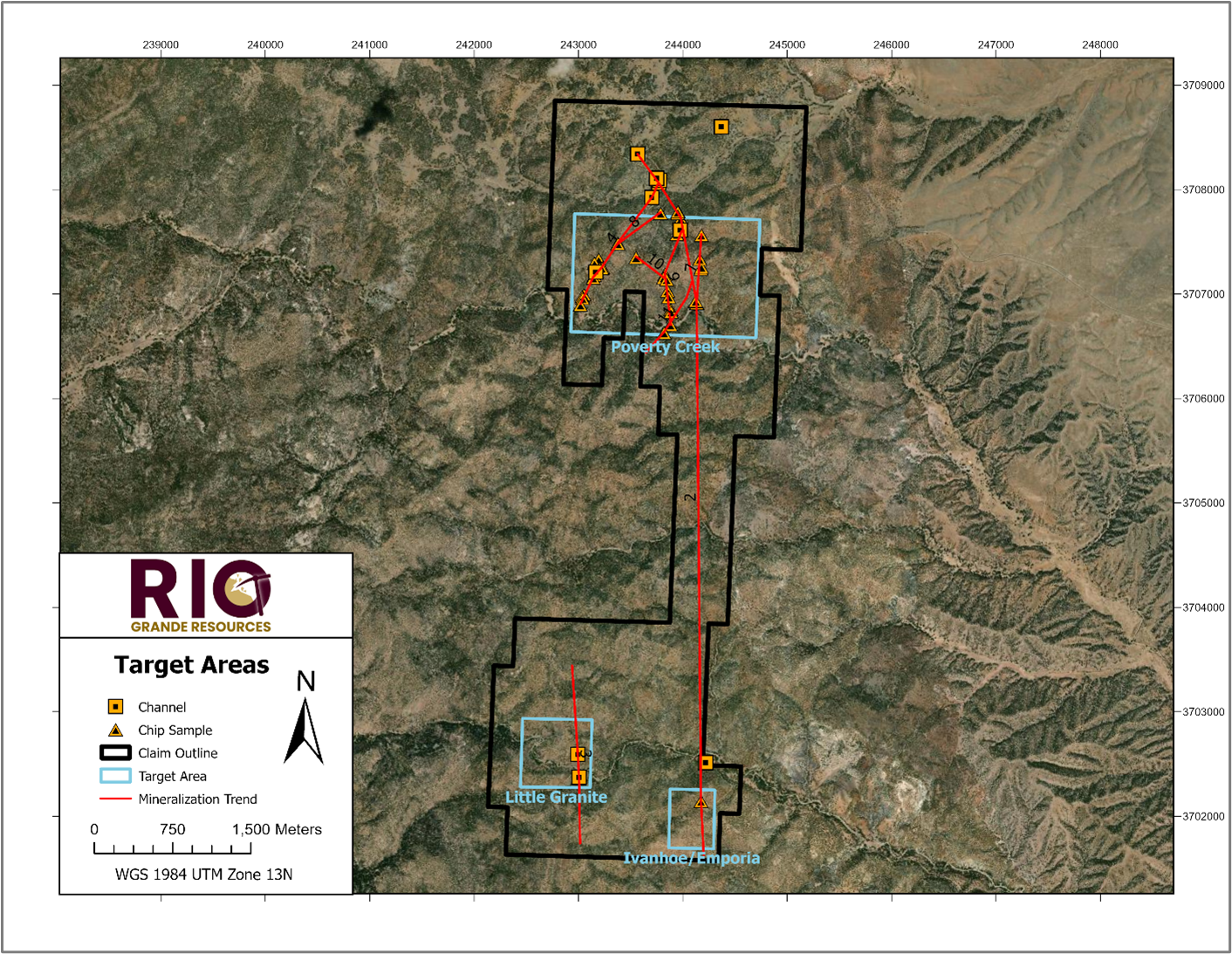
This expanded strike length supports the Company's interpretation of a district-scale, structurally controlled hydrothermal system organized by the Paymaster Fault corridor and associated subsidiary splay Paymaster Fault, the most significant structural feature on the project, associated with historical gold-silver vein deposits.
Channel-Defined Corridor (Northwestern Claim Block)
In addition to the newly identified Poverty Creek Trend, systematic channel sampling identified another structurally controlled mineralized corridor in the northwestern portion of the claim block. As part of the program, continuous channel samples were collected perpendicular to exposed in situ veins to better represent true vein width and mineralization distribution.
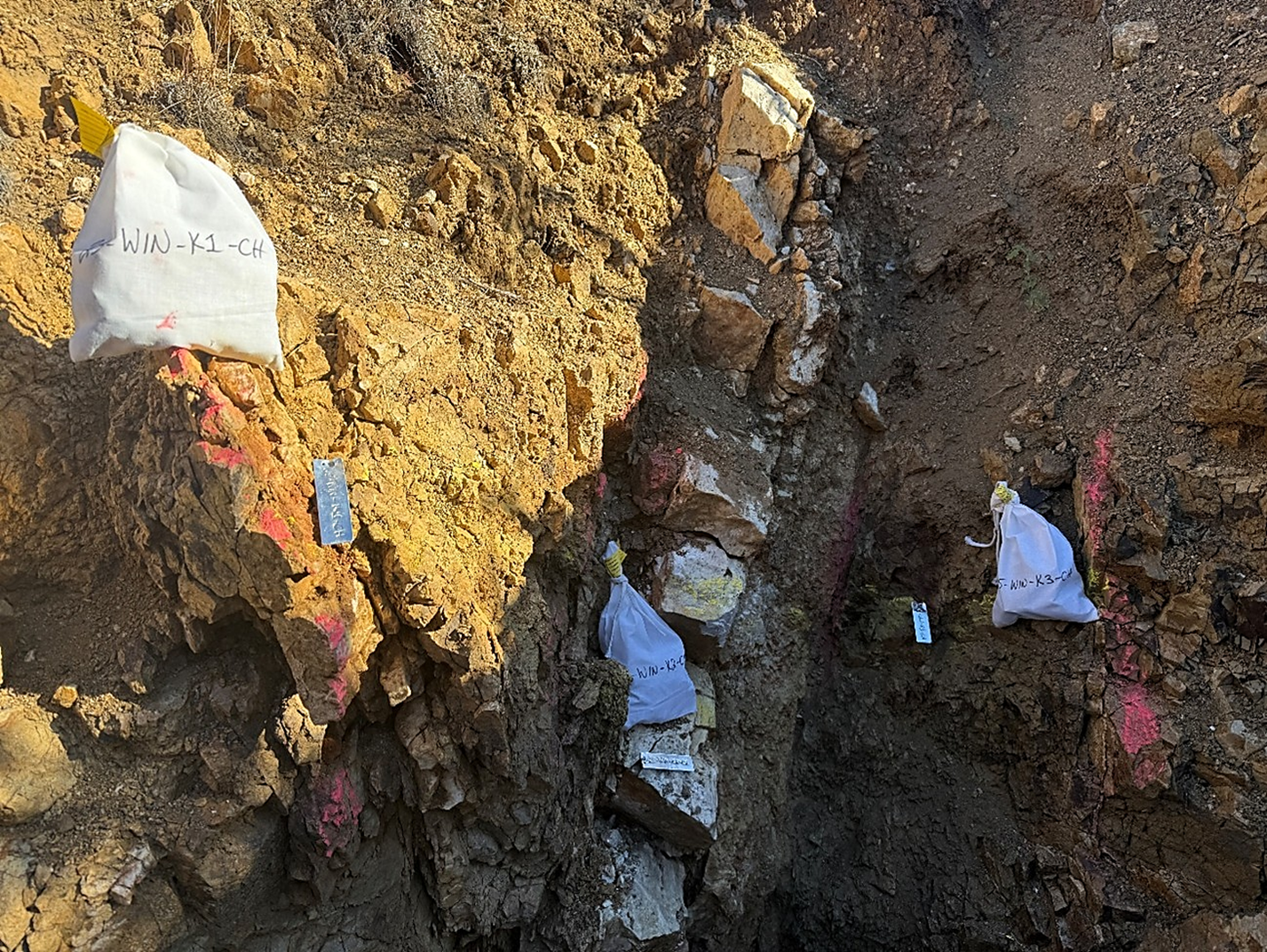
Channels C, G, and K (Picture 1 below) returned elevated gold and silver values and are interpreted to define part of a longer mineralized corridor extending toward the southeast end of the property (Figure 2). The spatial alignment of these channels suggests structural continuity along a vein system that remains open for further evaluation.
High-Grade Silver Associated with Historic Workings
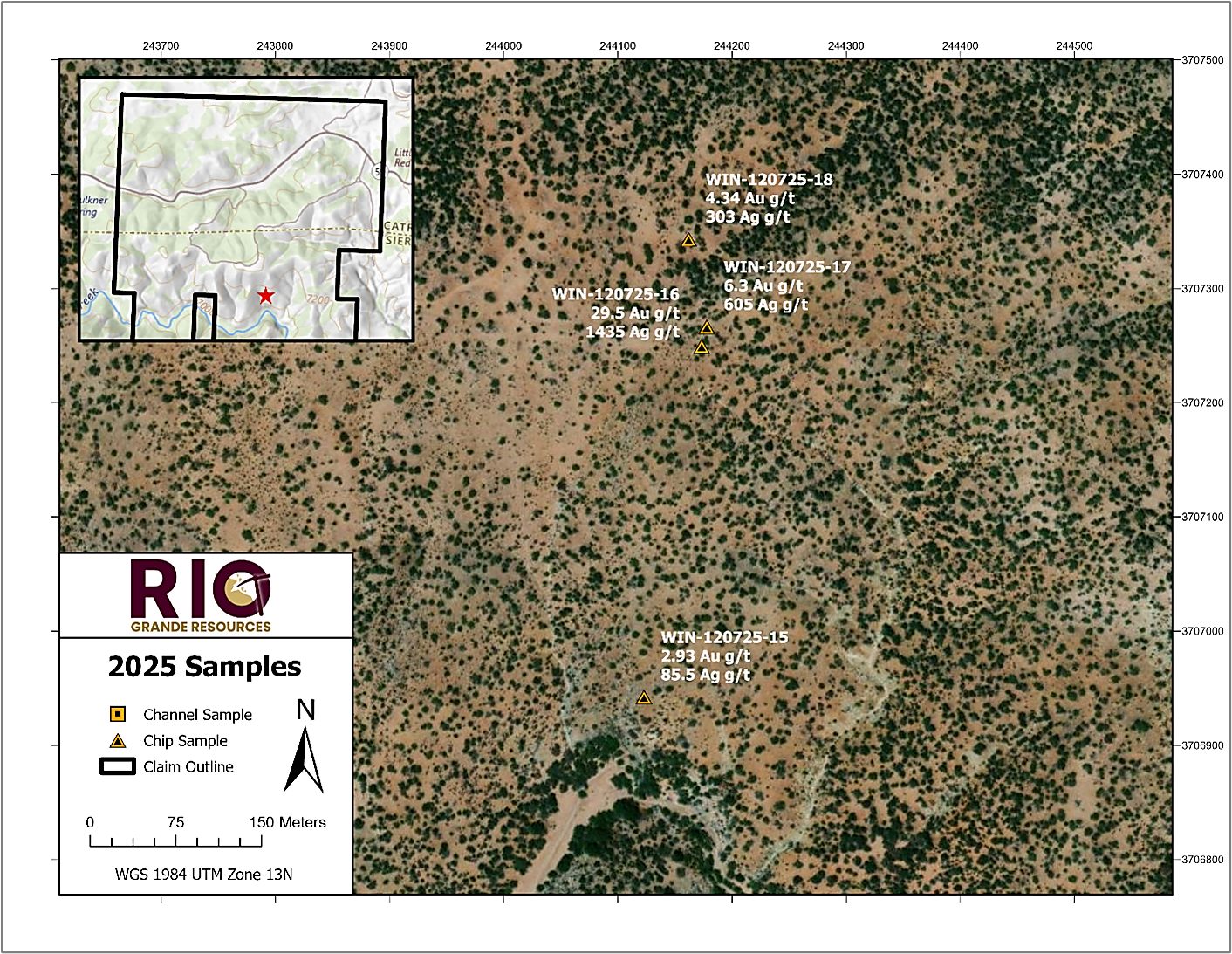
Rock chip samples 120725-15, 120725-16, 120725-17, and 120725-18 were collected along historic mine workings and previously mapped structures continuing south, illustrated in figure 3 below and returned significant silver values, including:
1,435 g/t Ag
605 g/t Ag
303 g/t Ag
85.5 g/t Ag
The Winston Project encompasses the past-producing high-grade gold and silver mines Ivanhoe and Emporia, along with the Little Granite workings. These historic operations confirm the fertility of the district and demonstrate the presence of structurally controlled high-grade mineralization within the current claim block.
These results suggest localized high-grade silver mineralization associated with structurally controlled vein systems and demonstrate that historically worked areas remain prospective.
Jason Barnard, President and CEO of Rio Grande Resources, commented: "The Winston Project is built around past-producing mines, including Ivanhoe, Emporia, and Little Granite, which historically demonstrated the presence of high-grade gold and silver within structurally controlled vein systems. The December 2025 sampling program, including first-pass results from the newly defined Poverty Creek Trend, further supports the Company's interpretation of an approximately 2.0 kilometre north-south, structurally controlled mineralized corridor across the Winston claim block and confirms that mineralization extends beyond historically developed areas into previously unsampled ground."
Mr. Barnard continues: "What is particularly encouraging is that high-grade mineralization is occurring in several structurally distinct zones, suggesting a broad, long-lived hydrothermal system capable of generating multiple vein sets and dilation zones. Our next phase of work will focus on refining these structural corridors, prioritizing the most prospective shoot geometries, and advancing the project toward drill permitting and systematic drill testing. We believe this disciplined approach to evaluating a district-scale system positions Winston as a highly compelling exploration asset and offers meaningful discovery potential for our shareholders."
Paymaster Corridor
In its June 18, 2025 news release, the Company reported approximately 1.5 kilometres of continuous mineralization along the Paymaster Fault corridor, including assays up to 66.2 g/t gold and 830 g/t silver and has demonstrated that high-grade mineralization is concentrated at structural bends and geometric complexities within the fault system. The sample results, including the channel-defined C-G-K trend, localized high-grade silver clusters, and the Poverty Creek vein system, occur within the broader structural architecture of the property.
The Winston Project lies within the Rio Grande Rift extensional regime, where repeated tectonic reactivation created long-lived hydrothermal pathways. Major fault corridors such as Paymaster are interpreted to have acted as primary fluid conduits, with subsidiary splays and structural complexities localizing mineralization. Collectively, the data support the interpretation of multiple structurally controlled mineralized corridors across the Winston Project.
Historic District Context
The Poverty Creek area lies immediately south of several historically documented Winston District properties described in New Mexico Bureau of Mines Bulletin 10 (1909), including the Great Republic, Keystone, and Minnehaha (Black Mountain Group) mines.1 Bulletin 10 describes north-south trending quartz veins hosted in fractured volcanic rocks and developed to shallow and moderate depths. In several cases, historic development was limited by structural disruption (including fault offsets) and water inflow, and Bulletin 10 notes that in some areas veins were reported to be cut off and not re-established at depth. This style of "interrupted development" is consistent with a structurally complex epithermal district where mineralized shoots can remain open beyond historic workings.
While historical information cannot be relied upon as confirmation of grade or continuity, these records provide context for the presence of structurally controlled vein systems throughout the district.
Next Steps
Rio Grande will continue advancing the Winston Project through a systematic and integrated exploration program. In addition to follow-up surface sampling and structural mapping in priority areas of the southern claim block, the Company intends to incorporate additional exploration methods to further evaluate the broader structural framework. The density of vein material, historic workings, and structural complexity makes this area a priority target for follow-up work. The objective of this work is to refine and prioritize target areas and advance the project toward potential future drill permitting and testing.
The Company cautions that although the results reported from rock chip samples confirm the presence of mineralization, these samples are selective in nature and do not constitute mineral resources. Further work, including drilling, will be required to determine the continuity, extent, and economic significance of mineralization.
Sampling, Analytical Methods and QA/QC
All Samples were collected by channel sampling and single sample rock chips. All samples were collected by Dahrouge and sent to ALS Laboratory in Tucson, Arizona for analysis. Channels were collected where exposed, in situ veins were found and laid out with a minimum of three sample intervals, a left host rock sample, a vein sample, and a right host rock sample. Channels measured from 0.45 m to 4.42 m in length. A continuous, perpendicular to strike line was drawn on the exposure across the sample intervals and chips were collected along that line for each sample. The bags were properly labeled, photos were taken of the exposure before and after sampling, and the location was marked with a metal tag. The sample locations were recorded using GPS. The single rock chip samples were collected where in situ vein exposures were discovered but no significant host rock was available to sample on either side of the vein making a channel impossible. The samples collected from these vein exposures were representative of the entire vein exposure as chips were taken across the vein perpendicular to the strike. Rock chip sample locations were also recorded using GPS. The samples were analyzed with 33 element, four acid ICP-MS digest and gold tested by fire assay ICP-AES. Blank samples were inserted for QA/QC purposes with an insertion rate of 1 per 10 samples. The blanks returned values below or near detection limits in all cases for gold and silver. The program was reconnaissance in nature; therefore no certified reference materials or duplicate samples were inserted during this surface sampling program. The Tucson ALS Laboratory is ISO/IEC 17025 certified by Perry Johnson Laboratory Accreditation, Inc.
Qualified Person
The scientific and technical information contained in this news release has been reviewed and approved by Mr. Jacob Anderson CPG, MAusIMM, a Qualified Person as defined under National Instrument 43-101. Mr. Anderson is independent of Rio Grande Resources.
The Qualified Person has reviewed the sampling procedures, analytical methods, and results disclosed herein and is satisfied that the information has been accurately presented. Verification included a review of field procedures, sample locations, and consistency with historical records.
About Rio Grande Resources
Rio Grande Resources (CSE:RGR)(OTCQB:RGRLF) is a burgeoning mineral exploration company focused on unlocking the high-grade gold and silver potential within its 3,000-acre drill-ready property in the Black Range of Sierra County, New Mexico. The company holds 100% interest in the Winston project group, which includes the 2 patented historic Ivanhoe & Emporia Claims, and Little Granite mines, all known for their past production of high-grade precious metals. Rio Grande Resources is led by a team of experienced professionals with expertise in mineral exploration and development, who are targeting additional precious metal discoveries within the property's well-documented low-sulfidation epithermal setting.
To view the company fact sheet and corporate presentation, please visit our website at www.riogranderesources.ca
Contact and Information
Company
Jason Barnard, President CEO and Director
(604) 767-6598
jason.barnard@riogranderesources.ca
Follow us or contact us on social media
X: @RioGrandeRGR
LinkedIn: https://www.linkedin.com/company/rio-grande-resources-ltd/
Facebook: facebook.com/profile.php?id=61572800435230
Forward-Looking Statements
Except for the statements of historical fact contained herein, the information presented in this news release and oral statements made from time to time by representatives of the Company are or may constitute "forward-looking statements" as such term is used in applicable United States and Canadian laws and including, without limitation, within the meaning of the Private Securities Litigation Reform Act of 1995, for which the Company claims the protection of the safe harbor for forward-looking statements. Such forward-looking statements and forward-looking information include, but are not limited to, the proposed benefits of the Arrangement. These statements relate to analyses and other information that are based on forecasts of future results, estimates of amounts not yet determinable and assumptions of management. Any other statements that express or involve discussions with respect to predictions, expectations, beliefs, plans, projections, objectives, assumptions or future events or performance (often, but not always, using words or phrases such as "expects" or "does not expect," "is expected," "anticipates" or "does not anticipate," "plans," "estimates" or "intends," or stating that certain actions, events or results "may," "could," "would," "might" or "will" be taken, occur or be achieved) are not statements of historical fact and should be viewed as forward-looking statements. Such forward-looking statements involve known and unknown risks, uncertainties and other factors which may cause the actual results, performance or achievements of the Company to be materially different from any future results, performance or achievements expressed or implied by such forward-looking statements. Such risks and other factors include, among others, the availability of capital to fund programs and the resulting dilution caused by the raising of capital through the sale of shares, continuity of agreements with third parties, the satisfaction of the conditions to the Arrangement, risks and uncertainties associated with the environment and delays in obtaining governmental approvals, permits or financing. Although the Company has attempted to identify important factors that could cause actual actions, events or results to differ materially from those described in forward-looking statements, there may be other factors that cause actions, events or results not to be as anticipated, estimated or intended. There can be no assurance that such statements will prove to be accurate as actual results and future events could differ materially from those anticipated in such statements. Although the Company believes that the expectations reflected in such forward-looking statements are based upon reasonable assumptions, it can give no assurance that its expectations will be achieved. Forward-looking information is subject to certain risks, trends and uncertainties that could cause actual results to differ materially from those projected. Many of these factors are beyond the Company's ability to control or predict. Important factors that may cause actual results to differ materially and that could impact the Company and the statements contained in this news release can be found in the Company's filings on SEDAR+. The Company assumes no obligation to update or supplement any forward-looking statements whether as a result of new information, future events or otherwise. Accordingly, readers should not place undue reliance on forward-looking statements contained in this news release and in any document referred to in this news release. This news release shall not constitute an offer to sell or the solicitation of an offer to buy securities. Please refer to the Company's most recent filings under its profile on SEDAR+ at www.sedarplus.ca for further information respecting the risks affecting the Company and its business.
The CSE has neither approved nor disapproved the contents of this news release and accepts no responsibility for the adequacy or accuracy hereof.
1 https://geoinfo.nmt.edu/publications/monographs/bulletins/10/
SOURCE: Rio Grande Resources
View the original press release on ACCESS Newswire