

from Temas Resources Corp. (CVE:TMAS)
Significant Gallium and Scandium Confirmed at La Blache as RCL Technology Platform Builds Additional Value
Latest drilling confirms thick, high-grade massive oxide mineralization and gallium, scandium and chromium associated with vanadium, titanium and iron, while western step-out holes extend mineralization toward surface and support potential resource and economic upside.
Temas has received assay results for all HQ diamond drill holes completed in November 2025 on the La Blache Project, confirming consistent, high-grade zones of gallium (Ga), scandium (Sc), chromium (Cr), coincident with vanadium (V), titanium (Ti), and iron (Fe) in the massive-oxide (MO) zone
Highlights include:
FT-25-07 with 73m @ 83.7% Fe2O3 + TiO2, 0.46% V2O5and
56 ppm Ga, 19 ppm Sc and 1,240 ppm Cr from 110m
FT-25-04 with 75m @ 79.8% Fe2O3 + TiO2, 0.43% V2O5and
57 ppm Ga, 17 ppm Sc and 1,463 ppm Cr from 204m
FT-25-06 with 40m @ 75.6% Fe2O3 + TiO2, 0.39% V2O5and
59 ppm Ga, 17 ppm Sc and 1,110 ppm Cr from 145m
FT-25-03 with 30m @ 78.7% Fe2O3 + TiO2, 0.39% V2O5and
53 ppm Ga, 16 ppm Sc and 1,294 ppm Cr from 214m
FT-25-05 with 26m @ 86.6% Fe2O3 + TiO2, 0.45% V2O5and
60 ppm Ga, 19 ppm Sc and 1,309 ppm Cr from 210m
FT-25-08 with 26m @ 84.6% Fe2O3 + TiO2, 0.43% V2O5and
58 ppm Ga, 19 ppm Sc and 1,258 ppm Cr from 108m
FT-25-09 with 24m @ 83.3% Fe2O3 + TiO2, 0.45% V2O5and
57 ppm Ga, 18 ppm Sc and 1,133 ppm Cr from 123m
Holes FT-25-06 to FT-25-09 confirm mineralisation extension up to 150m from the west of the historical drilling, where it shallows toward the outcropping mineralized Schmoo Zone. Mineralisation is thickening and remains open towards surface outcrops 500m to the west.
Temas' Regenerative Chloride Leach ("RCL") technology platform is ideally placed to process this multi-element mineralisation, with the accessory Ga, Sc and Cr potentially recoverable alongside Ti, V and Fe, adding significantly to the projects economics.
Temas' Fused Bead Assay Digestion Protocol for the 2025 samples has proven highly effective and is now being extended to all historic core. Historic core has been fully recovered in preparation for re-assay, with 748 samples from Temas' 2022 drilling already dispatched for re-assay under the new protocol in February 2026.
VANCOUVER, BC / ACCESS Newswire / March 12, 2026 / Temas Resources Corp. (" Temas " or the " Company ") (ASX:TIO)(CSE:TMAS)(OTCQB:TMASF)(FSE:26P0) is pleased to report assay results from the nine (9) HQ diamond drill program completed in the late 2025 at its La Blache Project in Quebec, Canada.
The 2025 drilling program was designed to test the limits of the thickest up-plunge massive-oxide (MO) intercepts on the property to date, to infill and confirm mineralisation between the historic drill holes and upgrade the current Foreign Inferred Resource to a JORC Complaint Measured and Indicated, and improve the confidence in the absolute values of the critical metals within the mineralised portion of the system.
Importantly, gallium, scandium and chromium mineralisation occurs within the same iron, titanium and vanadium system at Le Blanche. This supports the view that these accessory metals may form part of the revised resource and Preliminary Economic Assessment (PEA). The economics of the project will benefit from the Temas' proprietary RCL processing technology which is one of few platform technologies suited to complex and multielement mineralisation.
Mr. Tim Fernback, Temas Chief Executive Officer, commented:
"The consistency of the gallium, scandium, and chromium within the massive oxide zones at La Blache is highly encouraging and adds another layer of potential value to an already strong titanium, vanadium and iron system.
What stands out is that these critical metals are hosted within the same thick, high-grade massive oxide intervals that are central to the project, while the latest western holes have also confirmed that the mineralisation continues to extend and shallow toward surface.
Our updated Fused assay work is also showing meaningful increases in reported values from several key elements, reinforcing the importance of re-assaying historical core under the new Protocol. With 748 samples from 2022 program already submitted, we expect to build a much stronger picture of the overall metal inventory at La Blache in the near term.
At the same time, this style of multi-element mineralisation is well aligned with Temas' RCL technology, which we believe has the potential to enhance the value of the project beyond its existing titanium, vanadium and iron base.
This is truly an exciting step forward for the Company and our shareholders."
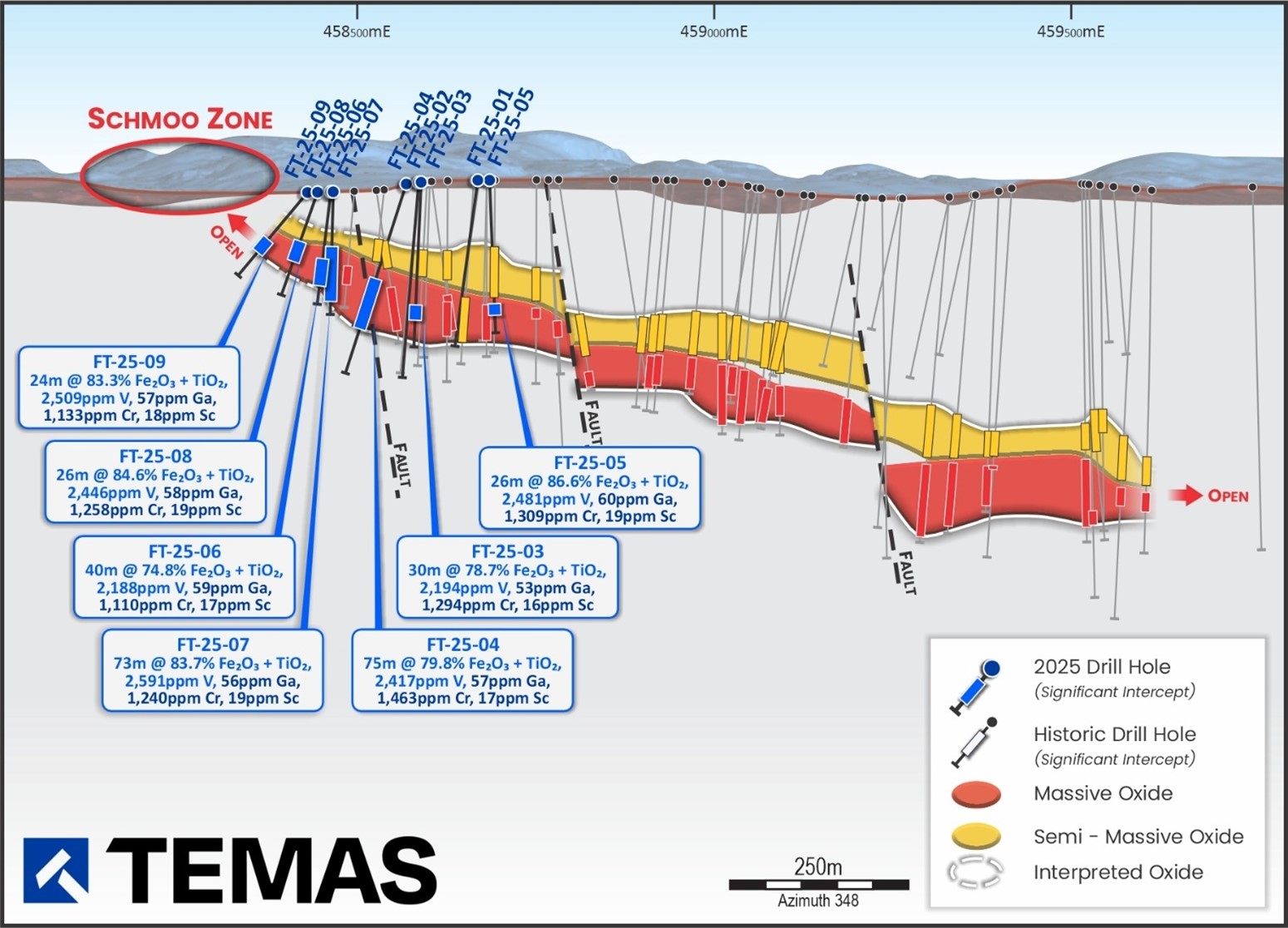
Figure 1: Long Section Schematic of the Farrell-Taylor Deposit, La Blache Project
Drill Program Overview
The 2025 drill program commenced on 24 October 2025, and ran for approximately 30 days, totaling 2,304 m of HQ over nine (9) holes. Temas utilised existing sites to construct drill platforms, capable of supporting multiple holes at varied angles and azimuths, with nine holes drilled from four platform areas.
The program had two overlapping objectives;
Holes #1 through #5 were designed to obtain detailed infill data to improve the existing local modeling and resource confidence and,
Holes #6 through #9 stepped out to the far west to test the possible to test beyond the interpreted termination of the Farrell-Taylor mineralisation.
Temas used HQ tooling to maximize the sample volume for large scale RCL pilot testing of the Farrell-Taylor (FT) deposit.
La Blache Mineralisation
The La Blache deposits are large lenticular bodies of massive Fe/Ti oxides hosted within the La Blache Anorthosite complex in the Grenville Province of Quebec. This geologic terrain is one of the most studied in the world, and is the host for Rio Tinto's world class Lac Tio deposit which has been in production since the 1950's. The deposits on Temas' land package were first discovered at about the same time as Lac Tio, and historic work including Temas 2022 Scoping study have demonstrated hundreds of millions of tonnes of high-grade massive oxide mineralisation.
The mineralisation at La Blache can be broken into two main styles tied to grade and geochemistry where grade of Fe 2 O 3 + TiO 2 + ~4.5% MgO represents a proxy for the relative percentage mineralisation that carry the valuable metals in this system. The host minerals and valuable metals targeted at La Blache are vanadium titanomagnetite (VTM) Fe 2+ (Fe 3+ , Ti 4+ , V 3+ ) 2 O 4 ), ilmenite Fe (Ti, V) O 3 and spinel (Mg, Fe 2+ ) Al 2 O 4 . The trace metals deport primarily to these oxide phases in varying amounts:
Massive-oxide (MO) domain has average concentration of valuable minerals ranging from 87-92%. This equates to about 8-13% gangue dilution but has traditionally been treated as a run of mine (ROM) feedstock to the RCL testing with excellent results to date.
There is generally no interruption of the high-grade MO, and the total oxide grades are very tightly grouped (example ranging from 88.5 to 91.9% in the core image provided below). The MO is considered a proxy for a traditional concentrate, and trace metals are near their peak concentrations in this domain. This natural concentration represents a gravity settling of the dense oxide minerals as they crystallized in a magma chamber and are characteristic of the La Blache mineralization where we generally see 10's and even up to 100m of apparent thickness in MO based on all the drilling completed to date across the whole property.
Semi-massive oxide (SMO) domain has a variable Fe/Ti oxide content ranging from around 20% up to overlapping the lower end of the MO grade range but distinguished by having more mafic silicate gangue mixed into the zone and a higher MgO (>4.5%) content. This gangue is composed of olivine with lesser amounts of Ca-plagioclase and clinopyroxene.
SMO is characterized throughout the drilling to date as an admixture of massive magnetite with a greenish mafic silicate (olivine and/or pyroxene) that is distinct from the anorthositic host rock. It generally has slightly elevated MgO over the average ~4.5% values seen in the MO. It has been broken out as a distinct geometallurgical unit and is not tied directly to the absolute grade of the material. It is almost always found above the MO in amounts that are seen to vary systematically across the FT deposit with a general thickening to the north across the mineralized body.
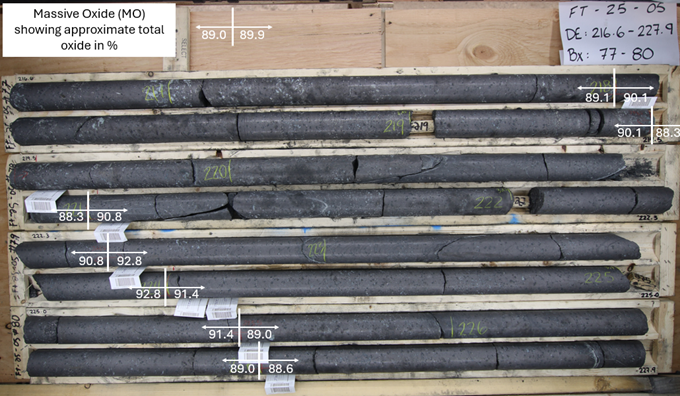
Figure 2; Core Photo of FT-25-05 216.6m - 227.9m as an example of the Massive Oxide Zone.
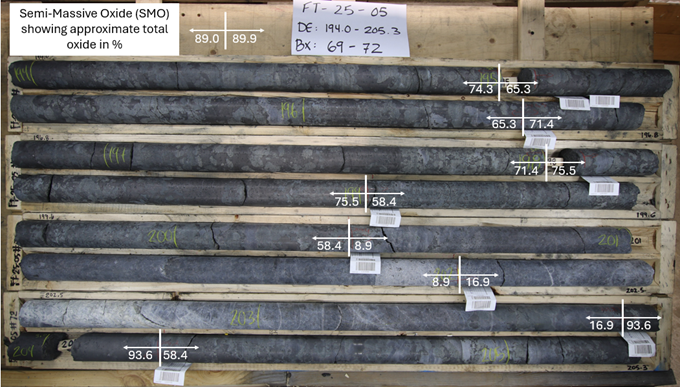
Figure 3; Core Photo of FT-25-05 194m - 205.3m as an example of the Semi-Massive Oxide Zone.
Table 1: Significant Drill Intercepts for all November 2025 Drilling*
Hole ID | From (m) | To (m) | Width (m) | Fe 2 O 3 + TiO 2 + ≤ 4.5% MgO (%) | Fe 2 O 3 + TiO 2 (%) | TiO 2 (%) | Fe 2 O 3 (%) | MgO (%) | V 2 O 5 (%) | Cr (ppm) | Ga (ppm) | Sc (ppm) | Mineral Domain | Total Mineralized Thickness (m) |
FT-25-01 | NSI | |||||||||||||
FT-25-02 | NSI | |||||||||||||
FT-25-03 | 187 | 196 | 8.3 | 59.3 | 55.4 | 13.3 | 42.1 | 3.9 | 0.246 | 582 | 38 | 14 | SMO | 41.7 |
205 | 208 | 3.4 | 42.9 | 39.3 | 9.6 | 29.7 | 3.6 | 0.153 | 349 | 28 | 11 | SMO | ||
214 | 244 | 30.0 | 82.8 | 78.7 | 17.8 | 60.8 | 4.2 | 0.392 | 1294 | 53 | 16 | MO | ||
FT-25-04 | 173 | 185 | 12.0 | 41.0 | 36.5 | 8.3 | 28.2 | 7.7 | 0.110 | 234 | 23 | 16 | SMO | 104.6 |
186 | 204 | 17.2 | 71.7 | 67.9 | 15.2 | 52.8 | 3.8 | 0.350 | 1092 | 50 | 16 | SMO | ||
204 | 279 | 75.4 | 84.0 | 79.8 | 17.9 | 61.9 | 4.2 | 0.431 | 1463 | 57 | 17 | MO | ||
FT-25-05 | 128 | 149 | 21.3 | 31.5 | 27.0 | 6.8 | 20.2 | 6.2 | 0.054 | 95 | 20 | 12 | SMO | 96 |
152 | 167 | 13.2 | 39.6 | 35.1 | 10.0 | 25.1 | 8.9 | 0.049 | 68 | 14 | 16 | SMO | ||
175 | 210 | 35.7 | 53.2 | 48.7 | 10.0 | 38.7 | 9.1 | 0.167 | 326 | 28 | 14 | SMO | ||
210 | 236 | 25.8 | 90.8 | 86.6 | 19.4 | 67.2 | 4.2 | 0.443 | 1309 | 60 | 19 | MO | ||
FT-25-06 | 142 | 145 | 2.5 | 70.9 | 66.4 | 12.3 | 54.1 | 13.7 | 0.253 | 565 | 37 | 16 | SMO | 42.8 |
145 | 185 | 40.3 | 78.9 | 74.8 | 17.5 | 58.1 | 4.1 | 0.391 | 1110 | 59 | 17 | MO | ||
FT-25-07 | ||||||||||||||