

from Wescan Goldfields Inc.
WESCAN GOLDFIELDS REPORTS ENCOURAGING DRILL CORE OBSERVATIONS IN FIRST HOLE OF 2026 DRILL CAMPAIGN AT MUNRO LAKE; ASSAYS PENDING
EQS-News: Wescan Goldfields Inc. / Key word(s): Miscellaneous
WESCAN GOLDFIELDS REPORTS ENCOURAGING DRILL CORE OBSERVATIONS IN FIRST HOLE OF 2026 DRILL CAMPAIGN AT MUNRO LAKE; ASSAYS PENDING
27.10.2026 / 12:05 CET/CEST
The issuer is solely responsible for the content of this announcement.
/NOT FOR DISSEMINATION IN THE UNITED STATES OR FOR DISTRIBUTION TO U.S. WIRE SERVICES/
Highlights:
- Visible gold identified in drill core from hole ML26‑005, the first hole of the Company's 2026 drill campaign at the Munro Lake Project
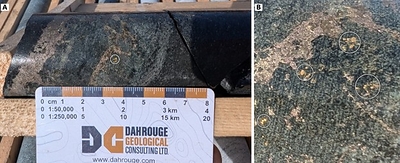
- The visible gold occurs as blebs and fine fracture fillings in a narrow sulphide- and diopside-rich calc-silicate shear at 33.4 metres downhole, over a core length of approximately 10 centimetres***
- ML26‑005 was drilled to test the North Vein Target in the Southeast Zone, where the Company recently identified visible gold in a quartz vein at surface (see news release dated October 19, 2026)
- ML26‑005 intersected a wide zone of high strain, interpreted to be the main shear structure hosting the North and South Vein Targets
- Assays are pending; the Company is sampling every hole of the 2026 drill campaign over its full length
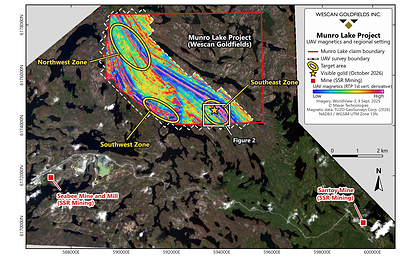
- Munro Lake lies 7 kilometres northeast of SSR Mining's Seabee mine and mill complex, Saskatchewan's only producing gold operation**
SASKATOON, SK, Oct. 27, 2026 /CNW/ -- Wescan Goldfields Inc. (TSXV: WGF) (FSE: W17A) ("Wescan" or the "Company") is pleased to announce that visible gold has been identified in drill core (Figure 1) from hole ML26‑005, the first hole of the 2026 drill campaign at its 100%‑owned Munro Lake Project in northern Saskatchewan. ML26‑005 was drilled to test the North Vein Target in the Southeast Zone, where the Company recently identified visible gold in a quartz vein at surface (see Company news release dated October 19, 2026). The 2026 drill campaign is ongoing (see Company news release dated October 5, 2026), and the Company anticipates completing it in early November.
The visible gold occurs at 33.4 metres downhole, in a narrow sulphide- and diopside-rich calc-silicate shear over a core length of approximately 10 centimetres*** (Figure 1). Within the shear, the gold is hosted at the margin of a stockwork vein of pyrrhotite, pyrite, quartz and chalcopyrite, where it occurs as blebs and fine fracture fillings in one larger cluster, with smaller clusters of finer grains aligned roughly along the foliation on either side. Very coarse diopside crystals occur within and adjacent to the vein, and the wall rock outside the shear is relatively fresh, with minimal shearing or alteration. The presence of visible gold, while considered encouraging, is not a reliable proxy for assay results: visible gold is not necessarily representative of the gold content of the interval, and visual observations are not a substitute for laboratory analysis.
ML26‑005 intersected a wide zone of high strain that the Company interprets to be the main shear structure hosting the North and South Vein Targets (Figure 2). Narrow, localized shears occur throughout the hole and consist of either quartz veining or sulphide- and diopside-rich calc-silicate, similar to the shear that hosts the visible gold. The visible gold is not associated with significant quartz veining, and the Company interprets the calc-silicate alteration to be related to a nearby quartz vein that the hole did not intersect. ML26‑005 was completed at a depth of 233 metres, and assays are pending. Because the distribution of gold can be unpredictable, it is not known which, if any, of the other shears intersected in the hole are gold-bearing. To combat this, the Company is sampling the entire length of every drill hole of the 2026 drill campaign.
ML26‑005 was drilled to test the North Vein Target in the Southeast Zone (Figures 2 and 3), the quartz vein that the Company's 2013 drill hole EXML‑002 was originally designed to test. Drill holes on the project are numbered sequentially across drill campaigns; holes 001 to 004 were drilled in 2013 (EXML‑001 to EXML‑004), making ML26‑005 the first hole of the 2026 drill campaign. On October 19, 2026, the Company reported several grains of visible gold in quartz vein material chiselled from surface at the North Vein Target, where the principal vein is exposed over a 25-metre strike length and the vein system is approximately 3 metres wide at surface. Historical grab samples* collected at the showing in 2012 and 2019 returned between 0.77 and 6.79 g/t gold. Assays of the surface samples are pending, and channel sampling across the vein is planned. Structural mapping at the showing measured an average vein plunge of 63 degrees toward an azimuth of 165 degrees (south-southeast), which the Company is using to orient its drill holes. ML26‑005 was collared approximately 43 metres south of the surface showing and drilled to the northeast at an azimuth of 37 degrees and a dip of −50 degrees (Table 1). The visible gold interval lies approximately 28 metres south-southeast of the surface showing in plan view, at a vertical depth of approximately 26 metres. The second hole of the campaign, ML26‑006, tested the same target further south along strike and down plunge (Table 1 and Figure 2). It intersected the same shear zone, with similar interbanded quartz veining and diopside alteration, and was completed at a depth of 251 metres; assays are pending.
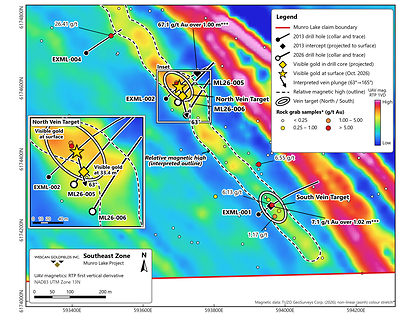
Table 1: Drill collar information for the 2026 drill holes (NAD83 UTM Zone 13N; azimuths relative to true north).
Hole ID | Easting (UTM) | Northing (UTM) | Elevation (m) | Azimuth (°) | Dip (°) | Depth (m) |
ML26‑005 | 593698 | 6174561 | 453.0 | 37 | −50 | 233 |
ML26‑006 | 593723 | 6174525 | 454.5 | 30 | −63 | 251 |
"Identifying visible gold in the first hole of the 2026 drill campaign is an encouraging start," said W. Connor MacNeill, Chief Executive Officer of Wescan. "ML26‑005 was drilled to test the North Vein Target, where we identified visible gold at surface earlier this month. We are sampling every hole over its full length and look forward to reporting assay results as they are received."
The 2026 drill campaign was originally scheduled to begin in the summer, but its start was moved to the fall because of delays in sourcing a drill and crew, compounded by a forest fire in the area over the summer. Drilling was subsequently interrupted for approximately one week by a mechanical breakdown. The drill has since been repaired and is fully crewed, and drilling is now progressing at a good pace.
* Surface grab samples, by their nature, are selective samples and may not represent underlying mineralization.
** Exploration on adjacent or nearby properties does not guarantee that similar mineralization exists on a specific property.
*** True thickness unknown.
Sampling and Analytical Procedures
Drill core is logged, photographed and sampled at the project. Core is sawn in half; one half is retained and the other is submitted to AGAT Laboratories in Calgary, Alberta, for gold analysis by fire assay, with samples containing visible gold analysed by metallic screen fire assay. Certified reference materials, blanks and duplicates are inserted into the sample stream for quality control.
Qualified Person
The scientific and technical information contained in this news release has been reviewed and approved by John Shmyr, P.Geo., of Dahrouge Geological Consulting Ltd., a registered member of the Association of Professional Engineers and Geoscientists of Saskatchewan. Mr. Shmyr is a "Qualified Person" as defined by National Instrument 43-101 – Standards of Disclosure for Mineral Projects ("NI 43-101"). Mr. Shmyr has verified the data disclosed in this news release and consents to the inclusion of the matters based on his information in the form and context in which it appears.
About Wescan Goldfields Inc.
Wescan Goldfields Inc. is a Canadian junior exploration company focused on the exploration and development of gold projects in northern Saskatchewan. The Company holds a 100% interest in four gold projects: the Munro Lake Project, located in the Pine Lake greenstone belt adjacent to the Seabee/Santoy gold camp; and, in Saskatchewan's historic La Ronge Gold Belt, the Jojay Lake Project, which hosts the Jojay gold deposit, the Fork Lake Project, which hosts the past-producing Jasper gold mine, and the recently acquired Lindsay Lake Project.
The Jojay gold deposit is the subject of a historic 2010 NI 43-101 compliant mineral resource estimate completed by A.C.A. Howe International Limited, comprising an Indicated Resource of 420,000 tonnes grading 3.7 g/t gold and an Inferred Resource of 630,000 tonnes grading 4.3 g/t gold (at a 2.0 g/t gold cut-off). The Jasper gold mine was operated by Cameco Corporation in the early 1990s and produced approximately 82,700 ounces of gold from approximately 140,000 tonnes grading 18.9 g/t gold prior to its closure. Shares of Wescan trade on the TSX Venture Exchange under the symbol "WGF".
Important Information Regarding Forward-Looking Statements
Information set forth in this news release may contain forward-looking statements. Forward-looking statements are statements that relate to future, not past, events. Forward-looking statements are often, but not always, identified by the use of words such as "seek," "anticipate," "plan," "continue," "estimate," "expect," "may," "will," "intend," "could," "might," "should," "believe," "scheduled," "to be," "will be" and similar expressions. Forward-looking statements in this news release are based upon the opinions and expectations of management of the Company as of the effective date of such statements. Although the Company believes that the expectations reflected in such forward-looking statements are based upon reasonable assumptions, it can give no assurance that those expectations will prove to have been correct. Forward-looking statements in this news release include, but are not limited to, statements relating to the Company's corporate strategy; the Munro Lake Project and its mineralization potential; the Company's 2026 exploration program, including, but not limited to, the ongoing 2026 drill campaign and its expected completion in early November 2026, the anticipated receipt and timing of assay results from ML26‑005, ML26‑006 and subsequent drill holes, the interpretation of the structures, alteration and mineralization observed in ML26‑005, and the planned channel sampling at the North Vein Target; the Company's objectives, goals, or future plans with respect to its exploration programs; and further exploration work in the future. These forward-looking statements are subject to numerous risks and uncertainties, including those described in the publicly filed documents of the Company, available on SEDAR+ at www.sedarplus.ca. Such risks and uncertainties could cause actual outcomes to differ materially from those anticipated or implied by such forward-looking statements. Accordingly, readers should not place undue reliance on the forward-looking statements contained in this news release, and such forward-looking statements should not be interpreted or regarded as guarantees of future outcomes.
Forward-looking statements are based on the Company and its management's good-faith assumptions relating to the financial, market, regulatory, and other relevant environments that will exist and affect the Company's business and operations in the future. The Company does not give any assurance that the assumptions on which forward-looking statements are based will prove to be correct, or that the Company's business or operations will not be affected in any material manner by those or other factors not foreseen or foreseeable by the Company or management, or beyond the Company's control.
The forward-looking statements contained in this news release are made as of the date hereof, and the Company does not undertake any obligation to update or revise any of the included forward-looking statements, except as required by applicable securities laws in force in Canada. The forward-looking statements contained herein are expressly qualified by this cautionary statement.
Neither the TSX Venture Exchange nor its Regulation Services Provider (as that term is defined in the policies of the TSX Venture Exchange) accepts responsibility for the adequacy or accuracy of this release.

 View original content to download multimedia:https://www.prnewswire.com/de/pressemitteilungen/wescan-goldfields-reports-encouraging-drill-core-observations-in-first-hole-of-2026-drill-campaign-at-munro-lake-assays-pending-302920157.html

27.10.2026 CET/CEST Dissemination of a Corporate News, transmitted by EQS News - a service of EQS Group.
The issuer is solely responsible for the content of this announcement.
The EQS Distribution Services include Regulatory Announcements, Financial/Corporate News and Press Releases.
View original content: EQS News
2423038 27.10.2026 CET/CEST